BPB Publications · 2026

Linux Performance

A 424-page, methodology-first guide to the diagnosis and resolution of Linux performance problems across CPU, memory, storage, networking, containers and eBPF, written by an infrastructure engineer.

424 pages· 18 chapters· Paperback, ebook & audiobook· ISBN 978-93-6589-009-9

Distributed worldwide by BPB Publications and listed on Amazon in 16 countries.

Pages
424
Chapters
18
Author's years in the field
18+
Amazon marketplaces
16

Why this book

Performance analysis requires method, not improvisation

Incidents are frequently closed by restarting a service, with no explanation of the underlying cause, and the problem subsequently recurs. This book sets out a systematic alternative: a diagnostic method that produces conclusions which can be documented and defended.

Method before tools

Formal measurement methodology, queueing models and bottleneck theory are established first, so that each metric is understood before further data is collected. The tooling is then introduced within an existing analytical framework.

Every subsystem, in depth

CPU scheduling and latency, memory and NUMA behaviour, the block layer and filesystems, and the network stack. Each receives dedicated treatment rather than a summary paragraph and a list of commands.

Drawn from production incidents

The case studies are drawn from production troubleshooting rather than constructed examples. They originate in high-severity enterprise incidents in which an incorrect diagnosis carried measurable cost.

Current tooling and platforms

Containers and virtualization performance, cgroup accounting, and a full chapter on eBPF observability alongside perf and ftrace, reflecting current practice.

Benchmarking and load testing

The construction of load tests whose results remain valid under production conditions, and the identification of benchmarks that measure the wrong quantity.

Capacity planning

The conversion of measured behaviour into headroom forecasts and scaling decisions that can be substantiated to stakeholders, rather than provisioning additional capacity speculatively.

Performance engineering is a specialised discipline rather than an afterthought. The objective of this book is to enable the reader to explain system behaviour precisely, justify the decisions taken, and demonstrate the resulting improvement.

Outcomes

What you will be able to do

Six specific capabilities, each applicable to the analysis of a live production system.

  • Measure Linux performance using the standard command-line tools, with a precise understanding of the quantity each one reports.
  • Diagnose CPU, memory, I/O and networking bottlenecks in production under live load.
  • Trace latency across scheduling and the system layers to establish where time is actually spent.
  • Collect and correlate metrics under realistic workloads rather than synthetic best cases.
  • Apply a repeatable methodology to isolate a problem and verify that the remediation was effective.
  • Improve capacity planning and production stability on the basis of documented evidence.

Table of contents

All 18 chapters

The book progresses from measurement theory through each subsystem into profiling and tracing, concluding with production case studies and eBPF.

  1. Introduction to Linux Performance Engineering
  2. Linux Kernel Evolution and Performance
  3. Performance Methodologies and Models
  4. Essential Linux Performance Metrics and Measurement
  5. CPU Performance Analysis and Optimization
  6. Memory Performance and NUMA Awareness
  7. Disk and I/O Performance
  8. Network Stack Performance
  9. Profiling Linux Kernel and Applications
  10. Modern Linux Tracing and Observability
  11. Advanced Memory, Filesystem, and I/O Stack Behavior
  12. Linux Tooling Landscape
  13. Benchmarking and Load Testing Essentials
  14. Container and Virtualization Performance
  15. Performance Tuning for Scalability
  16. Filesystem and Storage Optimization
  17. Case Studies on Troubleshooting in Production
  18. Advanced Observability with eBPF

Readership

Who this is written for

SREs and platform engineers

Responsible for service level objectives, and required to establish the cause of a breach and the measures that will prevent recurrence.

Infrastructure and systems engineers

Responsible for fleet sizing and architectural approval, and requiring capacity figures that remain valid under load.

Performance specialists

Already familiar with the tooling, and seeking the formal basis behind it: queueing theory, bottleneck analysis and measurement method.

Backend and kernel-adjacent developers

Working on code that performs well in isolation but poorly in production. The book addresses the causes of that discrepancy.

Senior sysadmins

Experienced in operational troubleshooting, and seeking a formal vocabulary and a repeatable procedure.

What you need first

Familiarity with the Linux command line and a working understanding of processes and memory. Prior kernel development experience is not required.

Ayan Kumar Nath

Staff Worldwide Technical Trainer, Nutanix

  • 18+ years in infrastructure, virtualization and reliability engineering
  • Former senior technical lead, VMware
  • Senior escalation engineer: vSphere, ESXi, hyperconverged platforms
  • Four-time VMware vExpert

About the author

Two decades of enterprise infrastructure engineering

Ayan Kumar Nath has worked throughout his career in environments where performance degradation and architectural error carry measurable operational and financial consequences. At VMware and subsequently Nutanix he served as a senior escalation engineer and technical lead on complex enterprise incidents across vSphere, ESXi and hyperconverged infrastructure, typically those escalated after initial investigation had failed to establish a cause.

This book derives from that work. Leading high-severity root cause investigations establishes two principles quickly: that a plausible theory has no value without a confirming measurement, and that most disagreements about performance are in fact disagreements about the definition of a metric. Both inform the organisation of the material.

He now teaches this material full time as a worldwide technical trainer. The book reflects that: it is written to be taught from, with the reasoning stated explicitly rather than left as an exercise for the reader.

Where to buy

Get Linux Performance

Available in paperback, ebook and audiobook. Purchasing directly from the publisher provides access to the combined paperback and ePub edition.

Best value

BPB Online, the publisher

Paperback ePub Bundle

Supplied directly by BPB Publications, who hold worldwide rights and ship internationally. The combined paperback and ePub edition is available only from this source, providing both a print copy and a searchable digital edition.

Buy from BPB Online

Amazon

Paperback Kindle

Listed on 16 Amazon marketplaces worldwide, in paperback and Kindle editions.

Buy on Amazon

Amazon links are affiliate links where an Associates programme is available. As an Amazon Associate the author earns from qualifying purchases, at no additional cost to the purchaser.

Questions

Frequently asked questions

Common questions regarding the book's scope, formats and availability.

Who is the intended readership?
SREs, platform and infrastructure engineers, performance specialists, kernel-adjacent developers and senior sysadmins, and more generally anyone responsible for systems where latency, throughput and stability carry operational cost. Working fluency with the Linux command line is required; prior kernel development experience is not.
Is a sample available before purchase?
Yes. BPB's free public preview covers the opening material and the full table of contents, and Google Play Books offers a free sample of the ebook edition.
In which formats is the book available?
Paperback (424 pages, ISBN 978-93-6589-009-9), ebook in ePub and Kindle (eISBN 978-93-6589-180-5), and an audiobook edition on Google Play. BPB Online additionally sells a paperback + ePub bundle that is not available elsewhere.
Does the book cover eBPF?
Yes. Chapter 10 covers modern Linux tracing and observability, and Chapter 18 is given over entirely to advanced observability with eBPF, including where eBPF-based tooling genuinely improves on perf and ftrace, and where it does not.
Which kernel versions does the book apply to?
It is written against current kernels, and Chapter 2 addresses kernel evolution and its performance consequences specifically. The methodology is deliberately version-independent and therefore remains applicable as the kernel and the tooling change.
Is the book available outside India?
Yes. BPB Publications holds worldwide rights and ships internationally, and the paperback is listed on sixteen Amazon marketplaces including the US, UK, Germany, France, Canada, Australia, Japan and Singapore. The ebook and audiobook are available globally.
How does this differ from other Linux performance books?
It is organised around diagnostic method rather than tool inventory. The formal material (measurement methodology, queueing models, bottleneck theory) comes first, and each subsystem chapter then applies that same framework, so that a single analytical approach is applied throughout rather than six unrelated toolkits. It also carries heavy modern coverage of containers, virtualization and eBPF, and closes with production case studies where the reasoning is shown rather than summarised.
Are the Amazon links affiliate links?
Where an Amazon Associates programme is available, yes. The author earns a small commission from qualifying purchases at no additional cost to the purchaser.
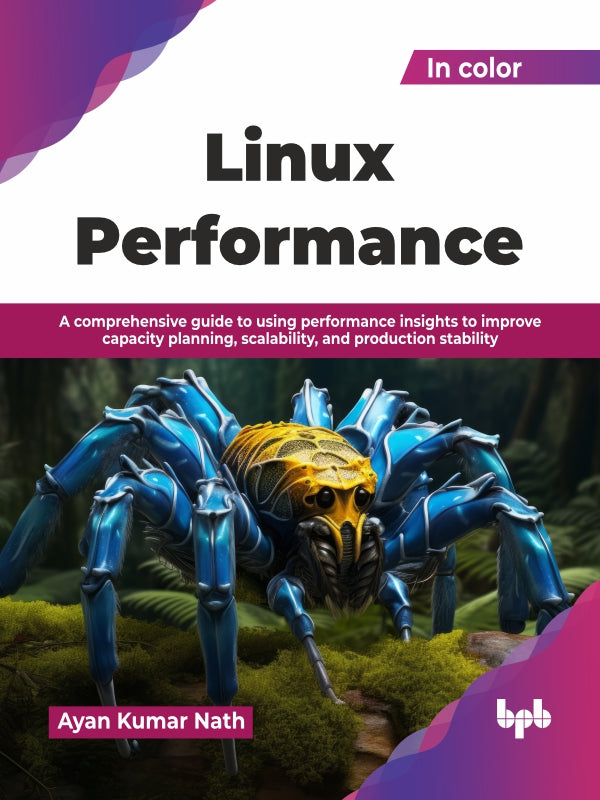
Preview

Review the preview before purchasing

The free preview covers the opening material and the complete table of contents, allowing the level and approach to be assessed prior to purchase.

Amazon, Kindle and audiobook editions are listed above.